
Amsterdam here I come!
I'm thrilled to announce my fellowship in the Netherlands starting this Fall. I will be coordinating a group of scholars studying the global state and future of democracy.

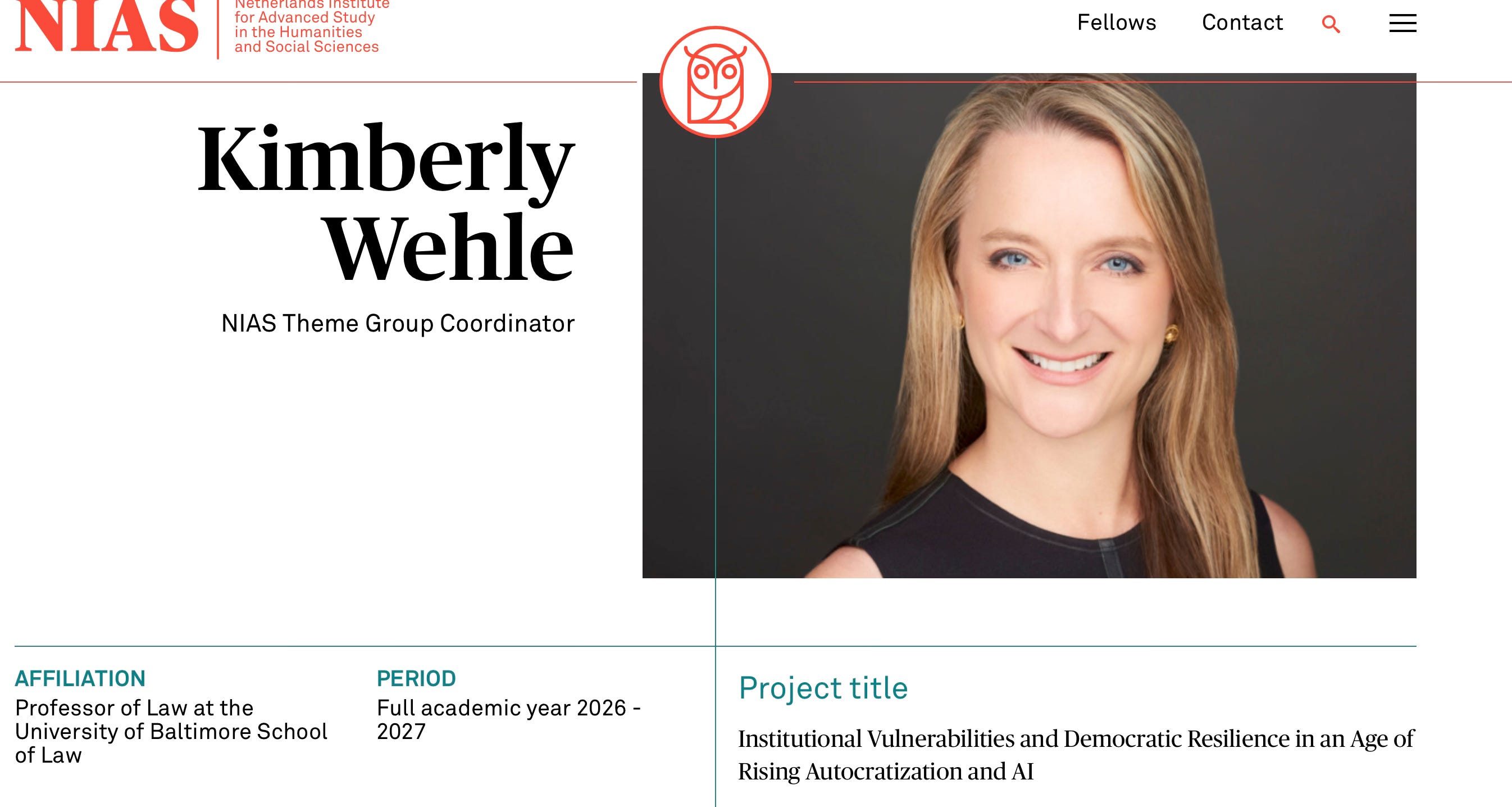
As some of you may recall, last Spring I had the honor of serving as a Fulbright Scholar at Leiden University in the Netherlands speaking and studying on the state of the American Constitution — and what people around the world understand democracy to mean.
That experience connected me with thinkers and policymakers in Europe who are watching closely what is happening in the U.S. They understand that the implications are serious for the rest of the world and want to take steps to stop U.S. democracy’s “illness” from spreading.
That led to a wonderful opportunity to work in Amsterdam next year building a framework with other scholars for understanding how democracy got to this precarious place and what we might collectively do about it.
I have been in the business of civic education around the Constitution and the rule of law for about a decade now. I stumbled upon this work when Trump first took office. One Sunday morning, I read a column in the New York Times containing a line pronouncing the President’s pardon power as “absolute.”
Absolute? That can’t be right, I said to myself. Every line of the Constitution is checked and balanced by other parts of the foundational document that rejected an unlimited monarchy. If a President pardoned only white people because they are white, that would bump up against the Equal Protection Clause, right?
After all, School House Rock (a 1970’s Saturday morning cartoon, for the young ones out there) and the musical Hamilton taught generations of Americans that we don't have kings. All exercises of the people’s power is accountable to the people. Or so we all assumed.
After reading the New York Times piece, I wrote my first op-ed for The Baltimore Sun to set the record straight. I then started writing more columns for the general public explaining legal stuff in plain language. Media outlets read my pieces. One day, the radio station WTOP in Washington, D.C., booked me to talk about one of my articles. Then someone at CBS News heard me talk on WTOP and booked me. CNN saw me on CBS and called. MSNBC saw me on CNN — and called. Then CBS News officially hired me to cover the Trump impeachment.
What followed were many hundreds of TV interviews, radio and podcast hits, op-eds in outlets like the Atlantic and the Bulwark, speeches, expert panels, four books, and this newsletter. I’ve been with ABC News for a few years now as part of my ongoing quest to demystify the law and the Constitution for non-lawyers. I write regular columns in The Hill and Zeteo.
Back in 2015, only a third of Americans surveyed could name all three branches of government. That number has risen over the last ten years, but a working understanding of why we are a democracy rather than something else — like a dictatorship, where decision-making is swift, absolute, and less messy than pluralistic electoral politics — is still way too rare among the American public.
I have no idea how my car’s engine works, so if it breaks down, I cannot possibly fix it. How can people be expected to protect the system of American government if they don’t even know how it works? Addressing that gap has become a personal passion.
It led me to NIAS.
The Netherlands Institute for Advanced Study in the Humanities and Social Sciences (NIAS) in Amsterdam, Netherlands, is an independent research institute in the field of the humanities and social and behavioral sciences founded in 1970. The group I will be coordinating is brand new. The focus is on academic freedom, but we will also be looking at multiple pillars of democracy, including an independent judiciary and a free press. As you all know, democracy is under pressure around the world. Illiberal and authoritarian leaders, parties, and movements — often labelled "populist" — are on the rise, and the institutions that have historically lent democratic systems their legitimacy are increasingly under threat.
I have spent years sound the alarm that democracy could fail in the United States if people didn’t step up and protect it. That entails facing the truth, finding deep courage, and taking risks. Across all my years doing this work, I have found that most people considered it virtually impossible that American democracy could one day fail. Or they found it too stressful to think about.
And here we are.
I have also taught thousands of law students in my 20 years as a law professor. As some of them might tell you, I am very passionate about my students and their futures. Our youth understand where things are better than older generations do. They know things are dire. That U.S. democracy isn’t working. They are anxious about their futures. Will there be jobs? Will there be freedoms for LGBTQ+ people? People of color? Women? Poverty and desperation are on the rise. Unaccountable billionaires and corporations have captured our government in the quest for more and more money and power. Gun violence is a way of life in America now. The warming planet — and AI — pose existential threats to humanity.
Meanwhile, our political and corporate elite are unwilling to do anything about it. Corruption at the highest levels of government is rampant. The list of horribles goes on and on. It wasn’t like this when many of us were in our 20’s.
What, you may ask, do I say when people wonder what we can do about this now?
My answer has both stayed the same and shifted over the years. What’s the same is that we must look the hard stuff in the eye. That means education, connection, conversation. Increasingly, there is work to be done in making sure that we are getting a complete and accurate picture of the truth. Algorithms, a repressive government, a culture of cruelty and lies, and AI delusion are blurring the line between reality and fiction. So we must be vigilant in our own education.
What’s different is what we can realistically do now.
(Besides vote. That goes without saying.)
One day, when this horror show shifts (and it will, that’s just how the world turns), those of use who care about liberty and equality and freedom and fairness will have a shot at building something new. I want to be ready. Our youth needs to be ready. When it’s their turn, they must be fully prepared to rebuild — something better, more modern, more sustainable. Now is the time to get them ready. You can be a part of that. Starting today.
That’s why I accepted the tremendous honor of a fellowship at NIAS. To think deeply about how we got here — an autopsy of American democracy, if you will, and what it means for other democracies that are still functioning across the globe. And then to think even more deeply about what a better society might look like for the next phase of human life.
I will still be teaching (remotely) at my beloved University of Baltimore. I will still be speaking here on Substack, and in my monthly column for Zeteo, and my twice-monthly column for The Hill, and as a legal contributor for ABC News, NPR, and C-SPAN.
I hope you keep reading and listening. It’s been a tremendous privilege to have this voice.
So thank you for your support. Thank you for believing in humanity — and the future for our children. Stay tuned and keep fighting, my friends!
If you value clear, accessible explanations of the legal issues shaping today’s headlines and support civic and constitutional education when this country needs it most, please join the paid edition of A Little Law School. Thank you.
I’m glad you’re here,
KW
The Little Law School with Kim Wehle is a reader-supported publication. To receive new posts and support my work, consider becoming a free or paid subscriber.
Check out my website for links to my books and speeches!

Want to learn more about a particular legal topic that’s been in the headlines? I’ve covered the biggest ones for nearly a decade. You can find hundreds of my op-eds on Linktree!
Multiple kudos, gal! We are proud of you for sure! (-:
Keep fighting, the world in general and this country in particular needs voices like yours now more than ever. I try to read all your posts and have read your book on the Constitution. Wish i could get a copy to everyone on the far right. as most of the traditional media has either been cowed into submission or outright bought out by those yielding the power in this country, voices like yours are so very important. good luck with your new challenge, a great country with great people. i have visited the Netherlands on business often and most of my colleagues over there know more about US politics than the average American... tragic.. good luck and do well...